

A prominent, misguided teaching is that the presence of fear constitutes a major problem. As a Cognitive Behavioral Therapist and Christian who cares deeply about mental and spiritual health, I have come to believe that one of the most important starting points for overcoming fear-based problems is the following truth:
Thoughts are thoughts
Feelings are feelings
You can experience any thought or feeling any place, at any time, and it can essentially mean nothing in terms of something different you need to do
Unfortunately, the very Christian church I love so very much is, in my mind, one of the main offenders of adding fear and burdens to people’s lives in terms of how the topic of fear is often handled. This does not in any way invalidate the claims of Christianity—I believe it highlights them. Christ frequently corrected and redirected both his own followers’ thoughts and beliefs and those of the outside world. He knows we are but dust but sees us and loves us (Psalm 103:14).
If you struggle with fear, I want you to know that you are not alone and that there is hope. Around here, I love to elevate the voices of others who speak wisdom in this age of noise. Guest writer, Michael M., shares how he got stuck in fear—and his way out. The following was provided from the author’s blog, Life Without Panic, with permission.
To slightly misquote what is clearly one of the greatest films in all of human history, lol, the Princess Bride:
Inigo Montoya: “You keep using that ‘phrase’. I do not think it means what you think it means.”
Whatever all the verses about fear in the Bible mean, one thing is certain. God wants us to face our fears. He does not want us to be cowards. And that’s a messy process. The saints in the Bible do what they need to do even when they are afraid.
Facing your fears often makes fear worse at first. Jesus, Paul, Gideon and Esther (to name a few) could have run and maybe reduced their fear. But they dove in and caused fear to happen to obey God.
If you are afraid of fear and panic, the most faithfilled and courageous thing possible is for you to face that monster and allow those sensations that terrify you. Allowing them is, weirdly, the process of you not being afraid of them.
Come with me for a moment and be the father of two small children that you love deeply. You know the type: The father who wants his children to grow into brave, healthy, loving people that will experience all the joys and sorrows of life with grace.
You have a ranch, and today you are going to take them to ride horses.
You bring out the horses, and while your children stare up at the beasts that are over twice their height, you say, “Do not be afraid, I am here, get up onto the horse.”
The first child refuses to climb up because, as he points out, you said not to be afraid, and he gets really scared when he approaches the horse (though someday he might climb up if he learns to not be afraid). Child number two gets up on the horse shaking and weeping but smiling knowing he is pleasing you. He rides off whooping out of both terror and pure joy. You can’t help but smile and feel his joy.
I ask you: Who fulfilled his father’s instructions?
Without a question: the second child.
Too many of us are the first child. Let’s try to fix that.
John Calvin in The Institutes talks about this sort of tragic biblical interpretation. Calvin 3.8.9: “Now also we have among Christians a new kind of Stoics, who hold it to be evil not only to groan and weep, but even to be sad and anxious. These lies are usually started by indolent men who employ themselves more in speculation than in action and practice.”
Old English, I know, but what he is saying, is that we have to look at the intent of passages. Being coldly precise with logic and linguistics often misses the point. Worse, it can make the loving comfort of a father into a curse.
God’s purpose in the “Fear Not” passages is not to make fear a sin, it is to provide comfort to His fearful children.
Let me say it most clearly: If you’re trying to obey God, and you are scared, being afraid is not a sin. It never is in this situation. Being a coward is.
I wish I could stop there. For most of us that have walked with Jesus for a long time, we know this is true, because we know him, and we understand His character. But for those of us that are doubting this, let’s look at the issue in detail.
When people take the verses to prohibit doing what we need to do in fear (because fear, after all, is a sin), people tend to do something very unhealthy. They tend to suppress their fear. When we suppress fear in a misguided attempt to obey God (note this), we are still afraid. We just buried it in our bodies. We just modify the symptoms of fear. We have achieved nothing.
I know this firsthand. I suffered from disabling and intense abdominal pain during stressful periods of my life when I thought that I had to rid myself of fear immediately to be godly. When I learned that the emotion of fear is not a sin, I was able to be free about those emotions that I was feeling and to bring them to God so that I could grow in a deeper faith and obedience. I was able to feel the fear and talk to God about the causes. Because of this, I no longer have disabling pain when my life gets really hard. Seriously.
Clearly, it would be great if we could grow immediately in our faith and not be afraid in order to move forward with whatever task or trial that God is calling us to, but that is rarely the case. The vast amount of time (both in life and in the Bible), we have to walk in a mix of anxiety and faith for at least a while.
The “fear not” verses are not, nor were they ever intended to be, restrictions against facing fear and feeling fear in our attempts to be obedient to Jesus. If that were not the case, Paul would have never gone to Corinth, Gideon to battle, Esther to the King or Jesus to the Cross.
All these people were afraid. But they did what God wanted them to do, even when it caused them to be frightened.
Listen to the words of Paul about his visit to Corinth. “I also was with you in weakness and fear, and in great trembling.” (1 Corinthians 2:3). He feared but he went anyway. Does he call it a sin? No. In his own judgment, it was a weakness. But was it bad? No, it was good, because it happened so that their faith “would not rest on the power of man but on the power of God.”
In Paul’s apostolic opinion, it was actually better this way.
And just in case you doubt that “weakness, fear and great trembling” refers to fear (lol), look at what Jesus says to Paul when his visit to Corinth is recorded in Acts 18:8-10:
8 Crispus, the ruler of the synagogue, believed in the Lord, together with his entire household. And many of the Corinthians hearing Paul believed and were baptized. 9 And the Lord said to Paul one night in a vision, “Do not be afraid any longer, but go on speaking and do not be silent, 10 for I am with you, and no one will attack you to harm you, for I have many in this city who are my people.” -NASB
Thank God Paul did not see his fear as a sin. The entire situation could have turned out tragically, and we may have never received 1 Corinthians 13!
Can you imagine if Jesus would have thought that fear and terror were sins in the garden? Here is the Christ, facing becoming the sacrifice for the sins of the world. And it is not just dying, it is about being (as the Apostle John puts it) the propitiation for the sin of the world—the appeasement of the wrath of God.
Jesus was going to experience the wrath of God – just as He had commanded and spelled out in Matthew 10: “Fear Him who is able to destroy both body and soul in hell.”
The result? Jesus sweat blood he was so stressed.
This condition occurs when blood or blood pigments mix with sweat due to ruptured capillaries in the skin. It is a rare condition, often associated with extreme stress.
Thank God neither Paul nor Jesus bought into this unbiblical idea that the emotion of fear is a sin. But also, thank God they were not cowards. They could have reduced or eliminated their fear by running, but they went forward and caused fear in order to be obedient.
So what do these “fear not” verses mean? I think that a mature interpretation of them is something like: Don’t let fear control you. I’m here. Have courage. Trust me. Obey me.
Don’t be a coward.
The reason that God addresses fear is that it can be a cause of not following Jesus -NOT because fear is wrong. If you love skydiving because it makes you afraid, go for it. I love mountaineering because it teaches me to love fear. And that makes me more likely to follow Jesus when I get worried about the direction He is taking me. Experiencing fear like this is not just permissible, it is utterly Godly, and it makes you more able to follow Jesus when things get really rough.
Practicing exposure therapy for panic is harmless, but it can be insanely scary, but doing it made me a thousand times more times free to follow Jesus than if I would have hid in my room and tried to muster up faith in a vacuum
Doing scary things out of raw faith and courage and even just for fun is a powerful way to become more Godly because God is right, we run from fear a lot- and our timing is often horrible. That’s why He spends so much time reassuring us.
And having fear that drives us to trust in God is always good. Always. Even when trusting God is super hard, and we do it poorly. At times like that, it takes courage to stay the course while we feel the pain that seems like it will never end.
I am sorry, but can you imagine the utter absurdity of taking “fear is a sin” to its natural conclusion? How many good things would then be a cause of (or even be) sin? Skydiving? Mountaineering? Surfing? Public Speaking? Getting married? Serving your country at a time of war? Being a police officer? Or are we supposed to just wait around until we have enough faith to experience no fear? Or maybe stop the action if we have doubts and fears?
Also, as a sort of footnote, God causes fear in certain cases. In Romans 13, Paul commands us that we should do good, but if we do evil that we should fear—for rulers are not a “cause of fear” for good behavior, but for evil. And those rulers were set up by God and are ministers of wrath toward those who do evil.
They were set up by God to cause fear in people that do evil.
And last (sorry for all these), Jesus commands us to “Fear Him who is able to destroy both body and soul in hell.” The entire idea of hell is a source of fear for vast quantities of people. And, not to be cruel, but think about how terrifying it would be to actually be there.
So two of the most fear-causing institutions for “evil doers” (and we all do evil at times) in all of history (Justice Systems and Hell) are created by God —and these are seen as good and just by the biblical writers.
Please note this: if the emotion of fear was a sin, we should expect the bible to be full of people asking for forgiveness for the emotion and God granting forgivness for that emotion. But very significantly, no one in the Bible EVER asks for forgiveness for being afraid. They only ask forgiveness for what their cowardliness led them to do. Conversely, God NEVER forgives someone for the emotion of fear. Only for the sinful acts arising from it.
If the “fear not” verses make fear a sin—especially with the overwhelming number of verses that encourage us to trust God and “fear not,” it is unthinkable that no one ever asked for forgiveness for fear. And even more unthinkable is the fact that God never grants forgiveness for it.
(I understand that this is an argument from negative evidence, but that is only a logical fallacy if you do not take into account all situations and times. These things are NEVER mentioned in the Bible. And that is the “universe” that we are touching on.)
But how do the saints of the Bible address the emotion of fear? Do they beg for forgivness? Do they cower in shame? No, they tell God that they are really hurting, and that they need God to help.
“My heart is in anguish within me; the terrors of death have fallen upon me. Fear and trembling come upon me, and horror overwhelms me.” King David, Psalm 55
This entire Psalm shows zero indication that it is a confession of sin. Instead it is an honest display of pain and a plea of faith to God for protection.
My faith is deepened in all of this as I read through all the passages where people were afraid and unwilling to do what God was asking (Moses, David, Peter). It always comes down to people not being willing to put themselves at risk. Ultimately, they were unwilling to be afraid and to step beyond where their faith was comfortable. They chose avoiding fear over the ever-expanding world of faith and courage and chose instead the small dark room of avoiding fear. Who pleases God are those that see the risk, feel the risk, and decide to obey God anyway. That is worship.
In conclusion:
Being afraid is not a sin. Being a coward is.
So as we move forward into the challenges in our life—challenges like confronting evil, or obeying God’s calling on your life, or maybe facing your fears with your counselor—never forget that crazy whooping kid on the horse holding on for dear life!
BE CHILD NUMBER TWO.
About Michael
Michael is a software professional, a thinker, and — most importantly — someone who has lived through and recovered from panic disorder.
He holds an MA in Theology from Westminster Theological Seminary.
For years, Michael battled panic attacks, confusion, and the exhausting loop of fear itself becoming the threat. He’s not a therapist or a doctor — but he is someone who has walked through the fire and come out on the other side. Now, he writes not from a clinical platform, but from the trenches of lived experience.
This site, Life Without Panic (Disorder), was born out of a desire to help others do what seemed impossible: recover by moving toward the fear instead of running from it. His approach blends time-tested exposure therapy principles with a deep commitment to the teachings of Christ — especially the paradoxical teachings of Jesus on facing threat with radical vulnerability.
When he’s not writing, Michael spends precious time with his four children and his (near perfect 😉 wife Sherri, climbs mountains in the Pacific Northwest, and tries to keep his coffee intake under control (with limited success).
You can follow Michael on his website, https://lifewithoutpanic.com/
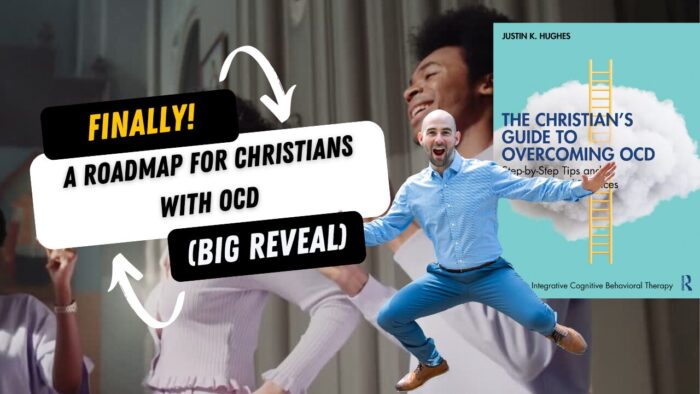
Find out how Christians can overcome their OCD—mind, body, and spirit—without sacrificing their faith. Get my new book, coming June 29th, 2026!
- Preorder now
- Start the Masterclass: You don’t have to wait for the book to access my comprehensive course that follows the same roadmap. Learn exactly the steps that evidence-based practices and faith involve.
- Follow along: Ensure you click on the “book” subscription here in my newsletter to get all updates and future promos!
- Watch the story on YouTube detailing the ups and downs and why it was worth 6 years.







Leave a Reply